


Hookah has always possessed a distinctive product culture. Traditional hookahs typically consist of components such as a base, a hose, and a bowl; the device itself carries a strong sense of ritual, creating a visual language quite different from that of standard electronic vaping products. As new form factors emerge in the vaping industry, the "E-Hose" design-exemplified by the Vapen E-Hose 60K Puffs Hookah-represents a product direction that blends hookah aesthetics with the structural logic of modern electronic devices.
From an industry perspective, the most noteworthy aspect of this type of product is not merely the "60K" in its model name, but rather how it reconfigures capacity, battery power, the atomization system, and the user interface.
1. What exactly is an E-Hose?
An E-Hose can be simply understood as an "Electronic Hose"-an electronic device styled after a hookah hose. Rather than merely replicating the components of a traditional hookah, it borrows the distinctive visual and usage concepts of hookah products and redesigns the device using electronic atomization technology.
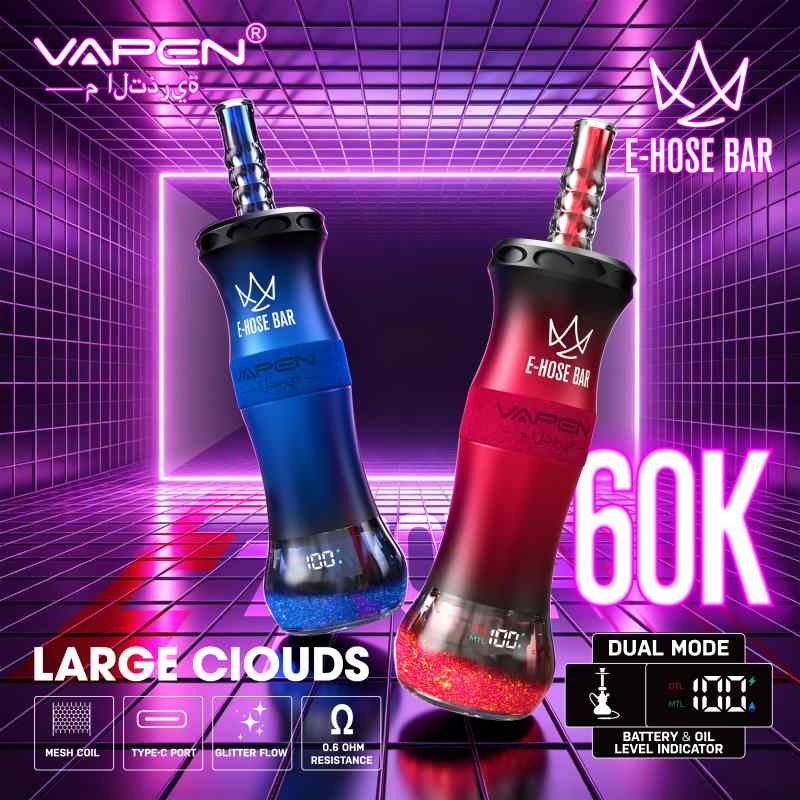
Traditional hookahs usually require the preparation of various accessories-such as shisha tobacco, a base, and a heat source-and the devices themselves are relatively large. In contrast, E-Hose products aim to minimize complex components by integrating the liquid reservoir, power supply, and atomization system into a single, cohesive unit.
Therefore, an E-Hose should not be viewed simply as a "miniature hookah." From a product development standpoint, it represents a distinct product category: one that retains the hookah style while adopting the structural logic of electronic devices.
The Vapen E-Hose 60K Puffs Hookah is positioned precisely according to this philosophy. The inclusion of both "E-Hose" and "Hookah" in its name signals an intent to establish a clear connection between modern electronic devices and hookah culture.
2. Why has high capacity become a key trend for electronic hookah products?
Capacity is a fundamental parameter in the design of electronic vaping devices.
The Vapen E-Hose 60K Puffs Hookah features a 50ml pre-filled e-liquid reservoir and is rated for a maximum of approximately 60,000 puffs. For the industry, the emergence of such high-capacity products reflects consumer interest in device longevity and convenience.
However, the "60K" rating does not guarantee that every device will consistently deliver 60,000 puffs in real-world use. Factors such as puff duration, frequency, the device's operating state, and other conditions influence the actual number of puffs. Therefore, a more accurate industry description would be "manufacturer-rated at approximately 60,000 puffs" or "up to approximately 60,000 puffs."
Similarly, a 50ml capacity does not equate to a fixed number of days of use. Capacity is merely one product specification; the actual rate of consumption depends on usage habits.
This is a common area for misunderstanding regarding high-capacity products in industry communications. The higher the number, the more important it is to provide clear specifications rather than simply highlighting an eye-catching capacity or puff count.
3. Pre-filled designs are transforming product architecture
Traditional e-liquid devices typically involve steps such as liquid storage, refilling, and replacement, whereas pre-filled devices come with the e-liquid already filled at the factory.

The Vapen E-Hose 60K Puffs Hookah features a 50ml pre-filled design; structurally, this means the liquid reservoir is integrated into the device's overall design. For distributors, one advantage of pre-filled products is the ease of standardizing specifications: capacity, flavor, packaging, and corresponding SKUs can all be managed uniformly at the factory level.
At the same time, however, pre-filled products impose stricter requirements regarding packaging labeling, storage conditions, transportation protocols, and compliance documentation for various markets.
Therefore, when sourcing products within the industry, one cannot rely solely on capacity figures. It is also necessary to verify specific SKUs, nicotine specifications, packaging methods, production batches, and regulatory requirements for the target market.
4. Why must battery and capacity be considered together?
The high-capacity liquid storage structure and the battery configuration are intrinsically linked.
The Vapen E-Hose 60K Puffs Hookah is equipped with a 1000mAh rechargeable battery and utilizes a USB-C port. For a device with a 50ml capacity, a rechargeable design allows the battery to be topped up throughout the product's lifespan, rather than relying solely on the capacity of a single-use battery.
However, it is important to note that a 1000mAh rating does not translate directly into a fixed duration of use. Factors such as the device's operating power, coil structure, and usage frequency all influence power consumption.
From an industry product development perspective, battery capacity should be viewed as part of the overall hardware solution. When increasing e-liquid capacity, designers must simultaneously consider how to balance power supply, atomization efficiency, and the device's physical size.
The USB-C port is a common interface standard for modern electronic devices. Its value lies primarily in standardization and charging convenience, though actual charging speeds depend on the specific circuitry and charging specifications of the product.
5. Why are mesh coils frequently found in high-capacity devices?
Mesh coils-heating elements made of a mesh-like material-have become a common atomization structure in vaping devices in recent years.
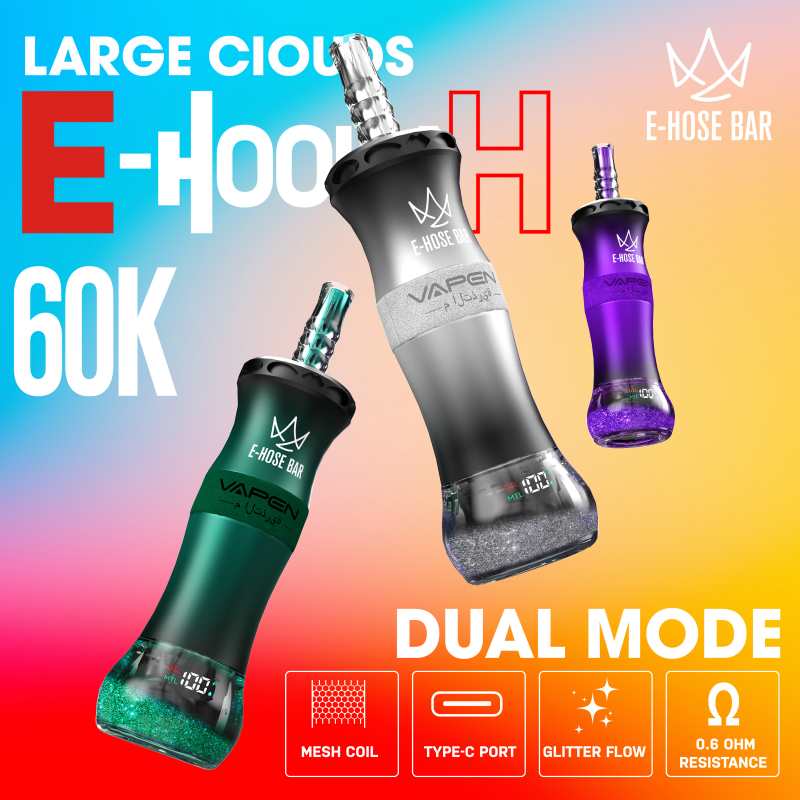
Compared to traditional coils, mesh coils utilize a mesh heating structure that offers a larger surface area for heating and vaporizing the e-liquid. The specific vapor volume and flavor profile produced are influenced by various factors, including coil resistance, power supply, e-liquid formulation, and airflow design.
The Vapen E-Hose 60K Puffs Hookah utilizes a mesh coil; this choice is structurally linked to its positioning as a hookah-style product. Hookah-style products typically prioritize vapor performance, making the atomization system a crucial element of product development.
However, from a professional product perspective, "mesh coil" should not be equated with a single, fixed user experience. The coil is merely one component of the entire atomization system; the product's actual performance must be evaluated based on the device's overall design.
6. What do dual MTL and DTL modes signify?
MTL and DTL are two common inhalation styles in the vaping industry.
MTL stands for "Mouth-to-Lung," referring to the method of drawing vapor into the mouth first before inhaling it into the lungs; DTL stands for "Direct-to-Lung," referring to the method of inhaling vapor directly into the lungs. The two differ significantly in terms of airflow openness and inhalation style.
The Vapen E-Hose 60K Puffs Hookah supports both MTL (Mouth-to-Lung) and DTL (Direct-to-Lung) modes; this means the product does not lock the user into a single inhalation style but instead offers varied airflow options through its design.
From a product development perspective, "dual-mode" capability is not merely a matter of adding a function button. It requires the precise alignment of airflow paths, intake structures, coil specifications, and device power output. In short, a truly mature dual-mode product tests the coordination of the entire system.
7. Why is the hookah style becoming increasingly common?
Visually, the vaping market is seeing a clearer trend toward stylistic segmentation.
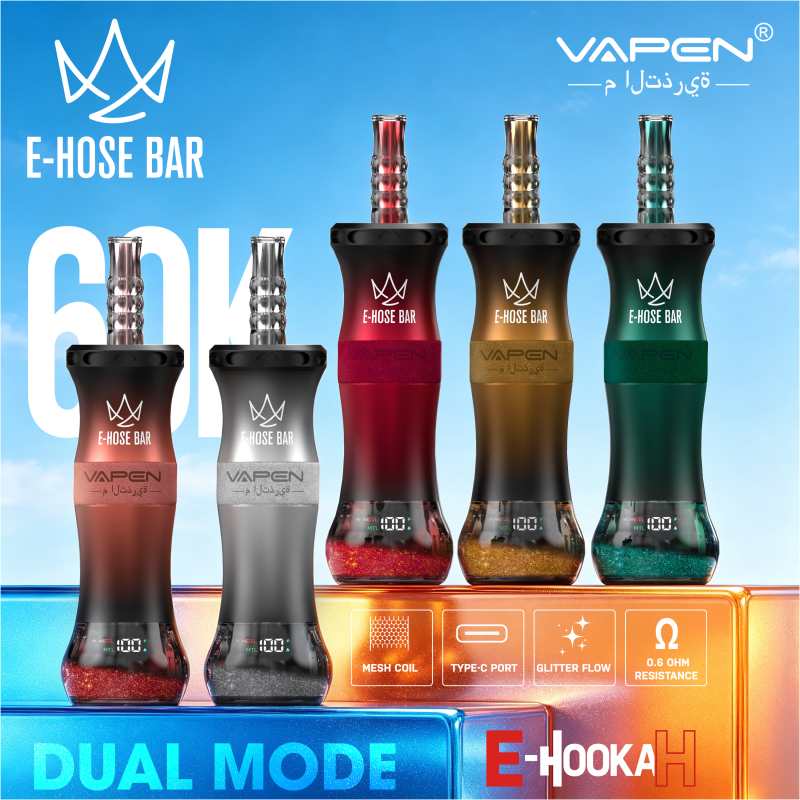
While past product designs often emphasized miniaturization, minimalism, and portability, hookah-style products employ a different visual language-one that highlights substantial size, distinctive styling, and cultural identity.
The emergence of E-Hose products offers a third approach. They neither replicate the complex structure of traditional hookahs nor mimic the appearance of standard e-cigarettes; instead, they carve out a new form of product expression that sits between the two.
This is precisely where the value of the Vapen E-Hose 60K Puffs Hookah lies. Its name, aesthetic direction, and hardware architecture all point toward the "electronic hookah" niche, rather than simply competing with standard disposable vapes.
8. Industry procurement: Look beyond the "60K"
For wholesalers, retailers, and procurement professionals, high-capacity models may grab the most attention, but the suitability of a purchase is often determined by more specific details.
For instance: What is the actual capacity? Is the battery rechargeable? What charging port is used? What type of coil is employed? What flavors are available? What are the nicotine specifications? Are there market-specific versions? What is the packaging quantity? Are all relevant certifications and compliance documents in order?
While these details may not be as eye-catching as the "60K" figure, they directly impact subsequent sales and inventory management.
This is particularly important given that different countries and regions may have varying regulations regarding nicotine-containing products, vaping devices, packaging labels, and sales channels. Therefore, when purchasing the Vapen E-Hose 60K Puffs Hookah or similar products, one should rely on the final specifications provided by the supplier and the regulations of the target market, rather than judging the product solely by its name.
9. Conclusion
From the perspective of industry evolution, the Vapen E-Hose 60K Puffs Hookah represents a clear product concept: it builds upon hookah culture for its visual identity and market positioning while incorporating modern vaping technologies-such as high-capacity e-liquid reservoirs, rechargeable batteries, mesh coils, and dual MTL/DTL modes.
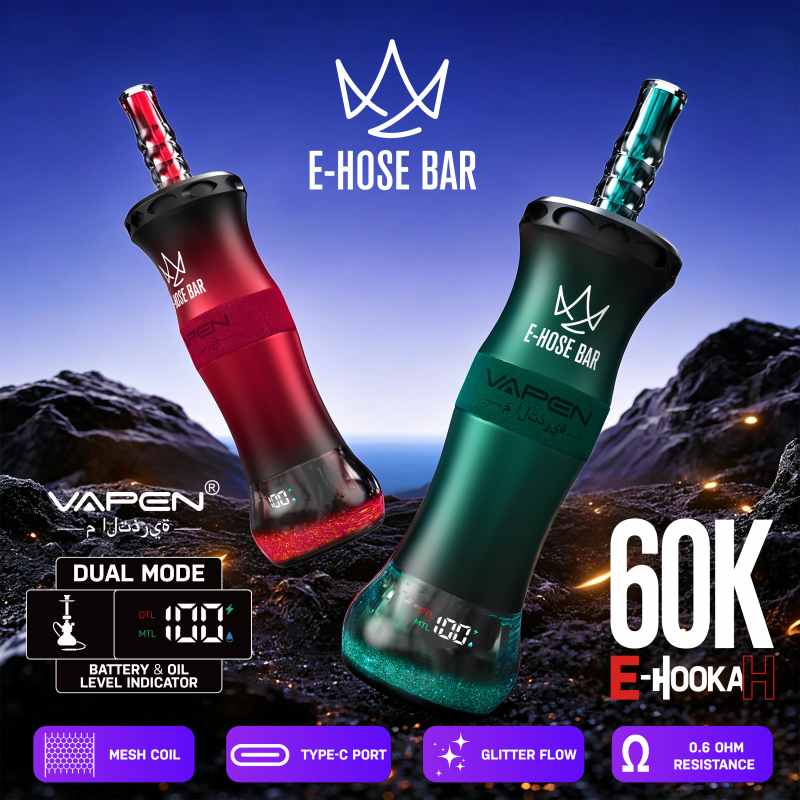
Its core specifications include 50ml of pre-filled e-liquid, a rated capacity of approximately 60,000 puffs, a 1000mAh battery, and a USB-C port; meanwhile, its "E-Hose/Hookah" positioning distinguishes it from conventional vaping devices.
Looking ahead, the true focus for the development of electronic hookah products may not simply be about inflating numbers, but rather about striking a more rational balance between capacity, hardware, structural design, aesthetics, and regulatory compliance. For industry professionals, this shift in product architecture is often more worthy of study than a flashy model number.